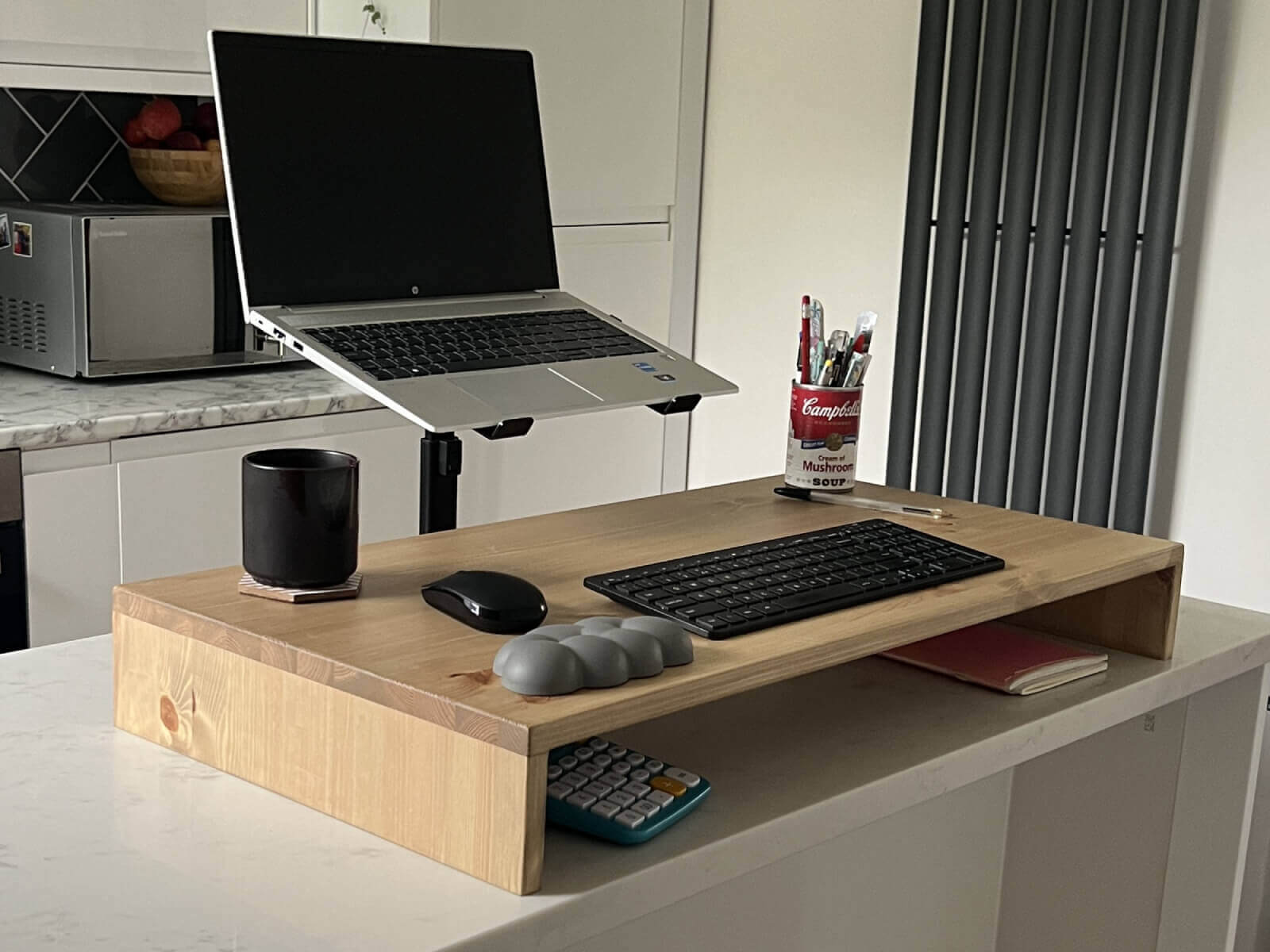

A riser desk, also called a desk riser or a standing desk converter, is a platform that sits right on top of the desk you already own. It lifts your monitor, keyboard, and mouse up to standing height, so you can switch between sitting and standing throughout the day without buying a whole new desk. The simplest way to picture it: a desk on top of a desk.
That framing matters because it explains why the product exists at all. Most people who consider a standing desk aren’t unhappy with the desk itself. They’re just tired of sitting for eight hours straight and want a way to break that up. Replacing an entire desk to solve that feels like overkill, and a riser is the middle ground.
How It Actually Works
You place the riser on your existing desk, put your monitor and keyboard on it, and adjust the height using whatever mechanism that particular model has. When you want to stand, you raise it. When you want to sit, you lower it back down. Most models fall into one of a few categories:
Manual, spring assisted. You squeeze a lever or handle and a spring does most of the lifting for you, so it doesn’t take much effort. This is probably the most common type on the market right now.
Gas or pneumatic lift. Similar idea, but the lifting force comes from a gas piston rather than a mechanical spring. Tends to feel smoother.
Electric. Push a button and a motor handles the height adjustment. Usually the most expensive option, and often the fastest to switch positions.
Crank operated. You turn a hand crank to raise or lower the surface. Slower than the other types, but simple and generally reliable.
Some risers are a single flat platform, good for a laptop or a light setup. Others have two tiers, a top shelf for the monitor and a lower tray for the keyboard and mouse, which tends to be the better option ergonomically since it lets your wrists sit at a more natural angle while typing.
Riser Desk vs a Full Standing Desk
The difference comes down to what actually moves. A full standing desk replaces your entire desk, and the whole surface, including the desk legs, adjusts height together. A riser sits on top of a desk that stays fixed in place, and only the platform itself moves.
That changes a few things in practice. A riser is cheaper and doesn’t require getting rid of furniture you already like. It’s also usually easier to move if you rent or change offices often. On the other hand, a riser takes up some of your usable desk space underneath it, and it generally offers a smaller work surface once it’s raised compared to a dedicated standing desk. If you’ve got a desk you’re attached to and just want to add movement into your day, a riser is usually the easier first step. If you’re setting up a workspace from scratch, a full standing desk might make more sense.
Is It Worth Getting One?
For most people who want to reduce how much they sit without a big investment or a major furniture change, yes. It’s a low cost, low commitment way to test whether alternating between sitting and standing actually fits into how you work, before deciding whether a full standing desk is worth the bigger spend.
The catch is that a riser only helps if it’s set up correctly. Your monitor should sit roughly at eye level, and your elbows should be close to a 90 degree angle when you’re typing, whether you’re sitting or standing. According to OSHA’s guidance on computer workstation ergonomics, poor screen height and wrist positioning are two of the most common contributors to strain injuries at a desk, and that holds true whether you’re using a riser, a full standing desk, or neither. Getting a riser doesn’t automatically fix your posture. It just gives you the option to change position, which only helps if you actually use it that way.
Bottom Line
A riser desk is a height adjustable platform that turns your existing desk into a sit to stand setup without replacing it. It’s a solid entry point if you want more movement during your workday without committing to a full standing desk, as long as you take the time to get the height right once it’s raised.
Read More: https://stepmagazine.online/
