
There’s a specific kind of disappointment that comes from a sofa arriving on delivery day and just not fitting the way it did in your head. Maybe it eats the whole walkway. Maybe it doesn’t even make it through the front door. Almost every version of that story traces back to the same mistake: skipping the measuring step, or doing it halfway.
The good news is this doesn’t take long, and you don’t need anything fancier than a tape measure and a notepad. Here’s the process that actually prevents the expensive surprises.
Start With the Room Itself
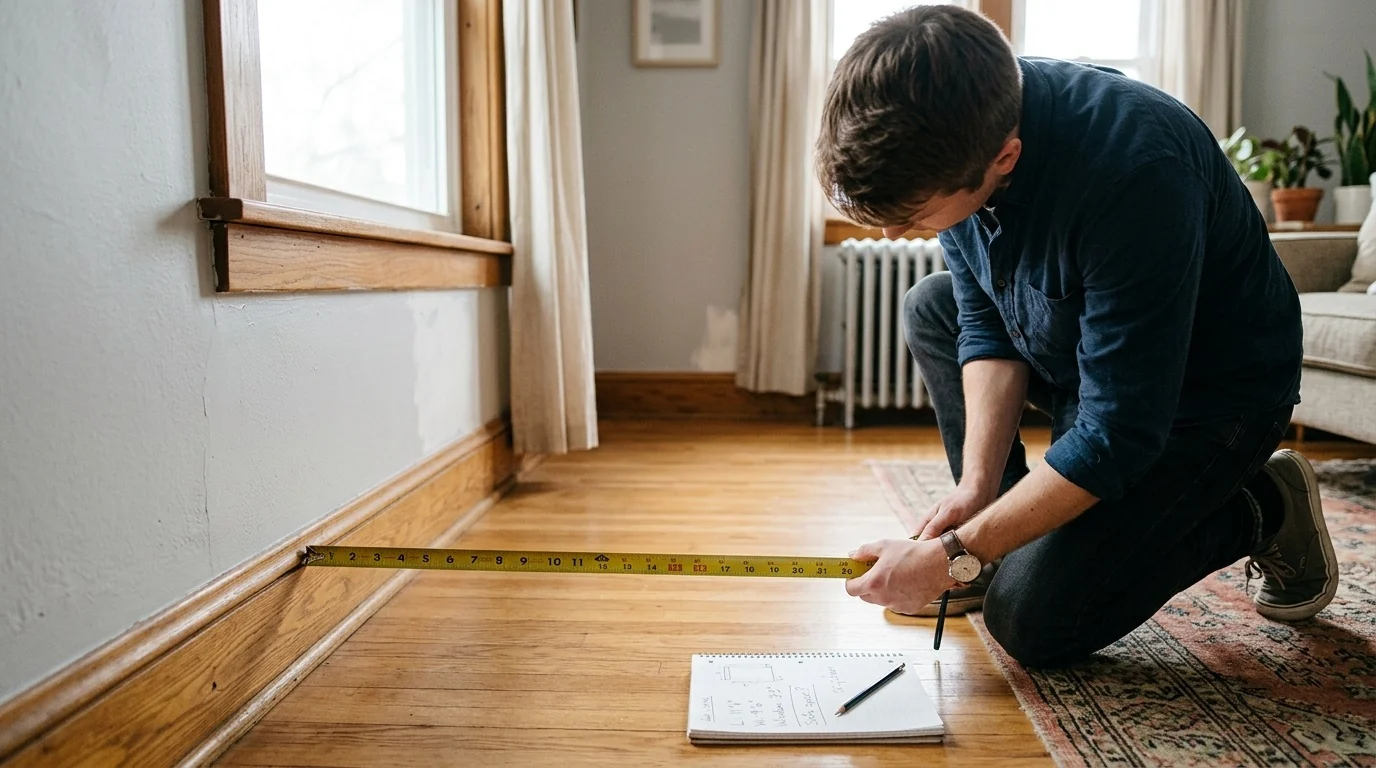
Grab a tape measure, not a phone app, if you can. Apps are fine for a rough estimate, but a physical tape measure at the baseboard is going to give you a more reliable number, especially in older homes where walls aren’t perfectly straight.
Measure the length and width of the room first, standing at one wall and running the tape across the floor to the opposite wall. Then measure the ceiling height, ideally in a couple of different spots, since older homes sometimes have small variations from one side of a room to the other. If the room isn’t a simple rectangle, sketch it out roughly on paper first, labeling each wall, and note any nooks, bump outs, or odd angles separately. That sketch becomes your reference for everything else.
Measure Every Doorway, Not Just the Room
This is the step people skip most often, and it’s the one that causes the actual delivery disasters. A sofa can fit perfectly inside a room and still never make it there because it can’t get through the front door, a hallway turn, or a narrow stairwell.
Measure the width and height of every doorway and passage the furniture has to travel through, from the front entrance all the way to its final spot in the room. If there’s a stairway or an elevator involved, measure those too. Use the interior opening measurement, not the outer frame, since that’s the space furniture actually has to pass through.
Know How Furniture Dimensions Are Actually Listed
Once you know your room, you need to be able to compare it against what a retailer lists on a product page. Furniture dimensions are usually given as width, depth, and height, and sometimes diagonal depth as well.
Width is typically measured arm to arm at the widest point. Depth runs from the front of the seat to the back of the frame. Height is floor to the tallest point. Diagonal depth matters specifically for tight doorways and hallway turns, since a couch that’s too deep to carry straight through an opening can sometimes still fit if it’s angled through diagonally. If a retailer lists that number, it’s worth checking, especially for bulky pieces like sectionals.
One thing worth double checking on any listing: whether the dimensions shown are for the assembled piece or the packaged box it ships in. Those two numbers can be different enough to matter, particularly for stairs and elevators.
Leave Room to Actually Walk Around
Fitting furniture into a room isn’t just about whether it technically fits against the walls. A room that’s crammed wall to wall with furniture stops feeling like a room you want to be in.
A reasonable rule of thumb is to leave at least 24 inches of space between seating pieces, like a sofa and a coffee table, and 30 to 36 inches for main walking paths through the room. Smaller side gaps of around 18 inches can work for tighter spaces, but the main traffic path through a room is worth protecting even if it means sizing down on a piece you had your eye on.
Test It Before You Buy It
Once you’ve got your numbers, there are two easy ways to sanity check a layout before committing to a purchase. The first is sketching a scaled floor plan on graph paper, using something simple like one square equals one foot, and mapping out where the new piece would sit relative to doors, windows, and existing furniture. The second is using painter’s tape directly on the floor to outline the actual footprint of the piece you’re considering. Walking around a taped outline on your actual floor tends to reveal problems a mental estimate misses completely, like a walkway that looked fine on paper but feels tight in person.
The Short Version
Measure the room, measure every doorway and hallway between the entrance and the final spot, and know exactly how the furniture’s own dimensions compare to both. Leave real space for walking, not just for the furniture itself, and if you’re unsure, tape it out on the floor before you order. It’s a fairly small amount of effort that eliminates most of the ways a furniture purchase goes wrong.
Read More: https://stepmagazine.online/
